How Data Centers Drive Up Energy Costs for Residential Areas—And Why Solar Energy is the Cost-Efficient Solution
Data centers have been around since the early 1900s (“What is a data center?”, n.d.).
But, modern technology is constantly evolving and the way we use artificial intelligence (AI) today is different than it was 100 years ago (“What is a data center?”, 2026).
Technologies like email, cloud storage, and ChatGPT are new technologies that have just surfaced within the past 10 to 50 years. And as the ways we communicate have changed, so have the ways we access things.
But that’s where data centers have stayed relevant.
The reality is that in everyday life, data centers help us to connect quickly with others, store our files and images via “the cloud”, and offer saved copies of our files in case of a system failure (“Data Center: Key Components”, n.d.).
On the other hand, data centers drive up energy costs for residential areas.
In this article, we’ll discuss why data centers have become an issue for rising energy costs and why residential solar power is the solution.
Data Centers and Rising Energy Costs
The biggest issue with data centers is that they’re quite literally power hungry. Data centers demand more energy than is available—meaning prices skyrocket for other consumers Reed, 2025).
In everyday terms, the price for energy is evenly divided amongst its users. When there’s one user who requires a lot more energy than others, unfortunately, other users suffer.
According to Ari Peskoe (2025), director of the Electricity Law Initiative at the Harvard Law School Environmental and Energy Law Program, “Facilities under development right now will use more energy than large cities” (as cited in Reed, 2025).
When you’re near a data center that’s using more energy than Chicago, unfortunately, you need to help foot the bill—unless there’s another option.
Thankfully, solar energy is an alternative.
Why Solar Energy Helps with Energy Bills
We have another article called How to Take Control of Your Energy Costs Using Solar Energy. But we’ll review the costs of solar energy again here.
On average, the grid-tie systems we install cost from $10,000 to $15,000.
But don’t let that number scare you.
As of March 2026, the average electric bill in Indiana is $160.83 per month (Electricity bill report, 2026).
If you do the math, $160.83 x 12 = 1,929.96 per year.
$1,929.96 x 7 = $13,509.72 at the end of seven years.
When you compare $13,509.72 to a $10,000 or $15,000 grid-tie system, you can see the numbers aren’t much different in the long run.
Plus, when it comes down to it, a grid-tie system pays itself off with 7 years—and doesn’t have the ongoing $160.83 adding up each month.
Now that you understand the cost of solar energy, let’s talk about residential solar energy installations, how they work, and how low maintenance they are.
How Residential Solar Power Works
There’s something scary about the thought of switching to solar power, right?
How does solar power even work?
Will my solar panels get damaged or hold up over time?
Do I have to do solar panel repairs and maintenance by myself?
But when it comes down to it, solar panels aren’t a mystery.
We’re here to support you and answer your questions every step of the way.
We’ve seen minimal damage to solar panels throughout our 12+ years in the industry, and we’ll be there to provide maintenance and repairs if needed.
So, we promise our 10-Year Workmanship Warranty, and 25-year Solar Panel Warranty have got you covered.
But to answer your other questions, let’s look at how solar panels work next.
How do solar panels even work?
Solar panels are made up of solar cells (cells which are usually silicon material).
Silicon captures and conducts photons—the type of energy the sun releases.
Captured photons knock electrons loose within the silicon solar cells.
But capturing photons isn’t enough. Energy from the sun must be converted from Direct Current to Alternating Current.
From Direct Current to Alternating Current
Within each solar panel, a layer of negatively charged silicon and positively charged silicon creates a force field to guide the freed electrons in a way that creates direct current.
From there, the direct current electricity needs to be converted to alternating current, since this is the type of electricity you currently use in your home.
This is where the inverter comes in. The inverter takes direct current converts it into alternating current, turning the sun’s energy into a source of energy that can power your home or business!
What started as photons (the sun’s energy from 93 million miles away) is now converted into a form of energy you can use to charge your phone, turn on the lights, or start your oven!
Now, let’s look at two of the systems we use to harness the sun’s energy in residential areas.
Our Residential Solar Options
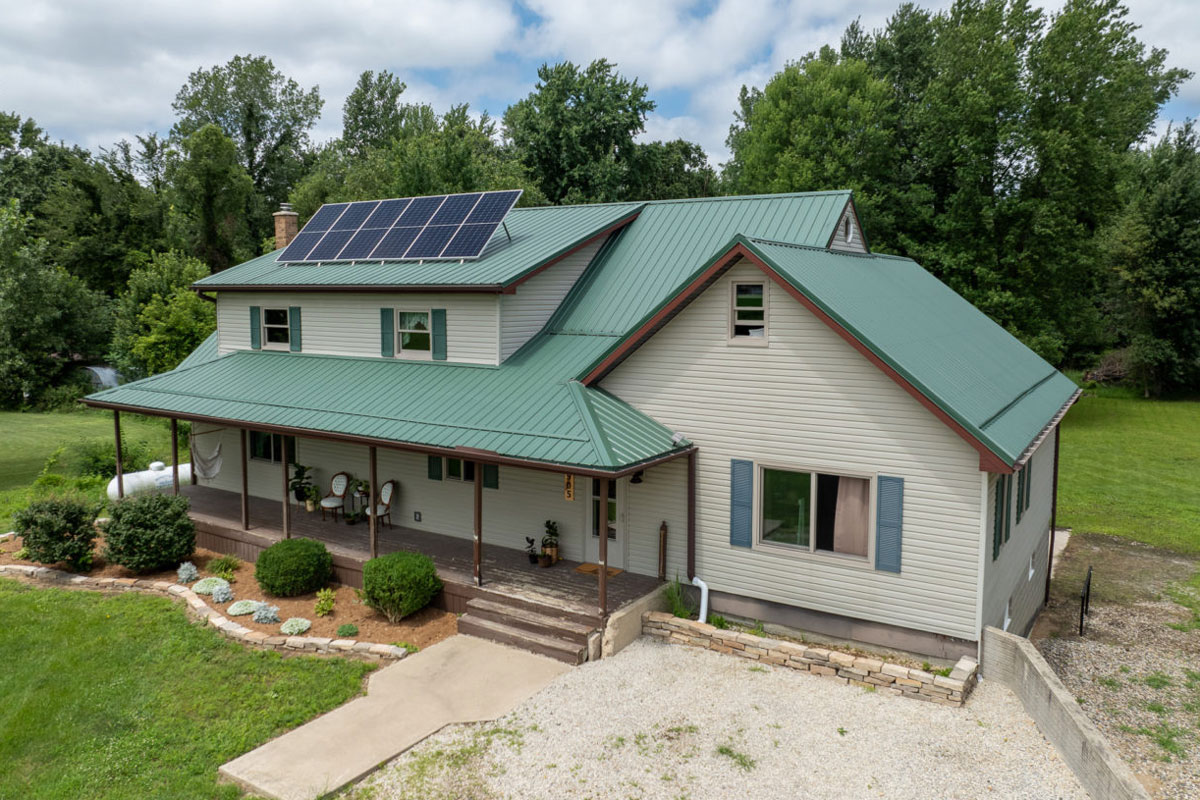
For residential solar installations our two options include grid-tie or hybrid grid-tie solar systems.
If you want a deeper look at the specifics of how solar panels take advantage of the sun’s energy, you can read more about it in our article How Solar Panels Work: The Basics Explained.
For now, we’ll give a brief overview of our two options.
Grid-Tie Solar Systems For Residential Homes
Grid-tie solar systems are the option that typically are paid off in seven years.
The Grid-Tie Solar System includes solar panels and an inverter—and sends excess energy to your local power grid (usually for 1/3 credit of what you’re charged for electricity).
These systems are more economically friendly since they don’t have a battery back-up like our Hybrid Grid-Tie Solar Systems.
On the other hand, Grid-Tie Solar Systems experience outages when the grid does unlike the Hybrid Grid-Tie Solar Systems.
Hybrid Grid-Tie Solar Systems For Residential Homes
Hybrid Grid-Tie Solar Systems have a battery backup for extra security during power outages.
These systems are more expensive than the Grid-Tie Solar Systems and extra energy is stored in the battery backup instead of being sent to the local companies like REMC and Nipsco.
For those who still want access to electricity as the weather changes, the Hybrid Grid-Tie Solar System is the way to go.
How Many Solar Panels Will I Need for My Residential Home?
Every household size varies, so the number of solar panels you’ll need will be based on the amount of electricity you currently use.
We start by looking at your monthly electric bill and go from there.
Our goal is to save you money in the long run, so we’re not going to install more solar panels than you need or force you to upgrade to the Hybrid Grid-Tie System.
If we can help you conserve energy, we will.
So, for those wanting to be eco-friendly, we recommend the Grid-Tie System and for those wanting access to energy during rain or shine, we recommend the Hybrid Grid-Tie System.
If you need solar for a remote area, we offer an extensive line of Off-Grid Products, including batteries, charge controllers, inverters, off-grid Solar Panels, appliances, Prewired solar kits, and portable Solar Sheds.
Get Started With a Residential Solar System Today!
Whether you invest in a Grid-Tie System or a Hybrid Grid-Tie System, we can help you take control of your energy costs and avoid the spikes that data centers cause near residential areas.
Instead of paying more than you should, choose solar energy to remain self-sufficient and live within your means!
Unlike your local electrical company, we care about saving you money—not taking anything we don’t deserve.
From the get-go, we want to know why you’re interested in solar energy, so we can best assist you and provide what you need.
Get a free estimate
The first step is getting a free estimate by calling or emailing us (information below).
Once you’ve received your free estimate, we’ll enter into a contract with you—guaranteeing our work and outlining our 10-year and 25-year warranties.
From there, we’ll put you on the schedule. Typical lead times are 4-6 weeks from initial scheduling, but this depends on how long the permitting process takes.
We cover the permitting process for you.
Once we have clearance, we start the installation process! This part is fairly seamless and typically takes 1-2 days until it is completed.
And there you have it—your Grid-Tie or Hybrid Grid-Tie System is ready to go!
Ready to get started?
Contact our Sales Manager Chester Gingerich at 260-499-3051 Ext 104 or email us at [email protected] today!
References
Data Center: Key Components And Their Role In Cybersecurity. (n.d.). Fortinet. https://www.fortinet.com/resources/cyberglossary/data-center
Electricity bill report: June 2026 (2026, June 1): Saveonenergy. https://www.saveonenergy.com/resources/electricity-bills-by-state/
What is a data center?. (n.d.). AWS. https://aws.amazon.com/what-is/data-center/
What is a data center?. (2026, May 13). Cisco. https://www.cisco.com/site/us/en/learn/topics/computing/what-is-a-data-center.html
Reed, R. (2025, September 3). How data centers may lead to higher electricity bills. Harvard Law School. https://hls.harvard.edu/today/how-data-centers-may-lead-to-higher-electricity-bills/